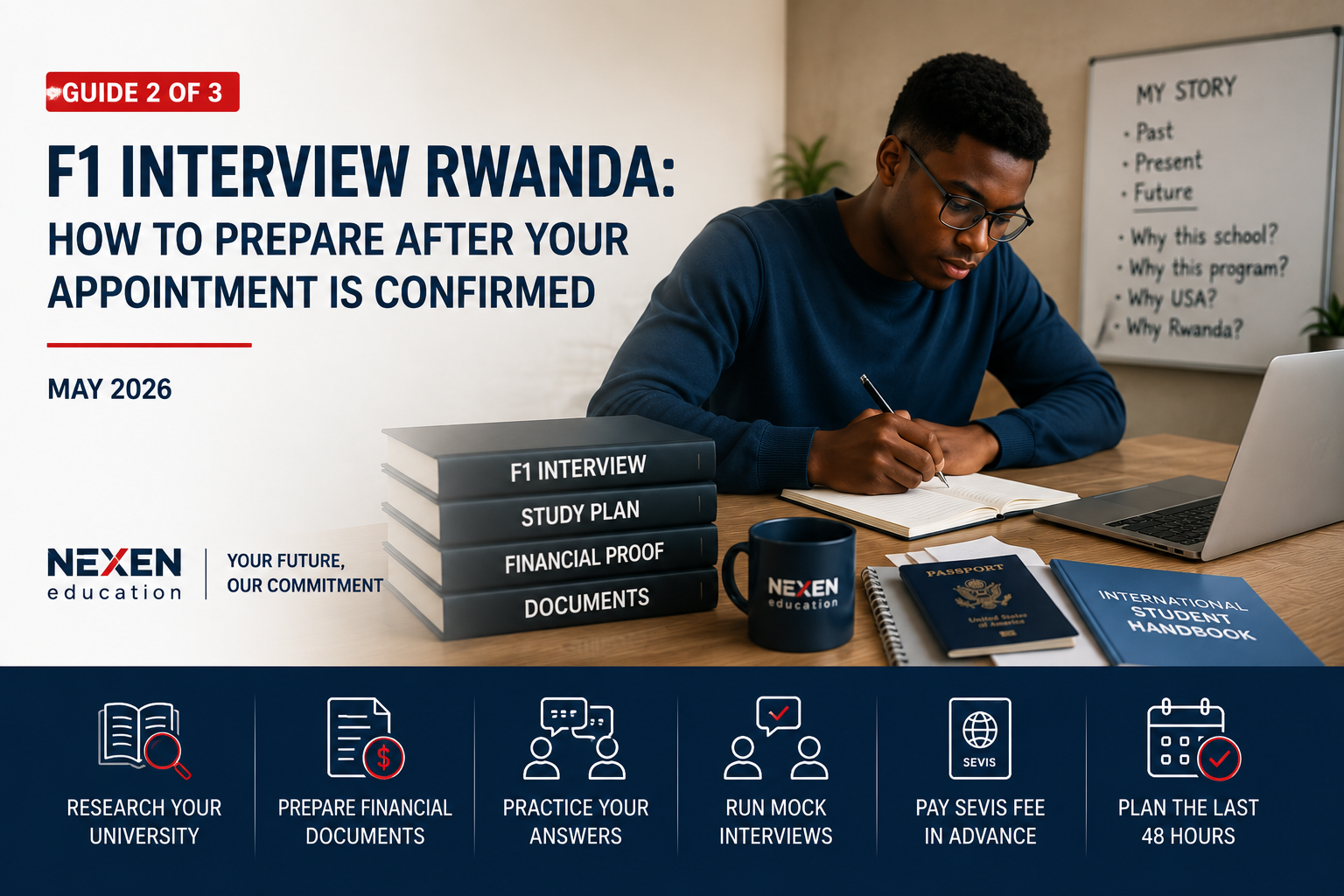
F1 interview Rwanda preparation guide. Research your university, rehearse answers, pay the SEVIS fee, and walk into your US Embassy Kigali interview ready.
Your F1 interview Rwanda preparation begins the moment your appointment is confirmed on usvisaappt.com. The application steps are behind you. Now the work shifts to your story, your documents, and your ability to explain your study plan clearly under pressure. This guide walks you through how to use the weeks before your appointment so you walk into the US Embassy in Kigali calm, organized, and ready.
This is part two of a three-part series. Part one covered the application process from I-20 to appointment booking. Part three covers what to expect on interview day at the embassy itself.
In this guide, you will learn
1. Researching your university more deeply 2. Building your fit story 3. Preparing your financial proof and documents 4. Rehearsing answers without memorizing 5. Running effective mock interviews 6. Paying the SEVIS fee before your appointment 7. The last 48 hours before your interview
Step 1: Go Deeper on Your University
Most F1 interview Rwanda refusals do not come from bad documents. They come from students who cannot explain, in a few sentences, why this particular school is the right fit for them. The interview is short, often three to five minutes, and the consular officer is trying to understand whether you have made a thoughtful choice.
You should be able to answer these questions without hesitation.
- What is the name of your university and where is it located?
- What program will you study and what does it actually cover?
- Why this school and not another?
- Is there a specific professor, course, lab, or research group that interests you?
- What does student life look like there?
Spend a few evenings going beyond the admission letter. Read the program page. Look at the course list. Watch student videos on YouTube. Visit the international student services page. If you find a professor whose research connects to your interests or to Rwandan priorities such as the goals laid out in Vision 2050, that is a strong, specific detail to mention in your interview.
The goal is not to memorize facts about the school. The goal is to talk about it the way you would talk about something you actually care about.
Step 2: Build Your Fit Story
A fit story is a short, honest explanation of why this school, this program, and this country make sense for you right now. It connects three things.
- Where you have been, meaning your academic background and interests
- Where you are going, meaning your studies and what comes after
- Why this school is the bridge between the two
You do not need a long speech. Two or three clear sentences are enough. For example, if you are studying agriculture and your school has a strong research program in food systems, you can talk about how that program connects to your interest in working on agricultural innovation back home. If you found the school through a specific course that does not exist in your country, mention the course.
The strongest fit stories are specific. The weakest are generic. "Good education" and "best country" tell the officer nothing about you.
Step 3: Organize Your Financial Proof and Documents
The consular officer needs to be confident that you can pay for your education and that the funds are real. This means your financial documents must be clear and consistent with what you say in the interview.
Common documents to prepare
- Valid passport
- Form I-20 from your US school
- DS-160 confirmation page
- Appointment confirmation from usvisaappt.com
- MRV fee receipt from Access Bank Rwanda
- SEVIS fee payment receipt (covered in step 6)
- Admission letter from your school
- Scholarship letter if you have one
- Bank statements from your sponsor
- Sponsor's employment or income proof
- Affidavit of support if relevant
- Academic transcripts and certificates
- Any test scores such as TOEFL, IELTS, or Duolingo
Put these in a clean folder in a logical order. The officer may not ask for every document, but having them ready and organized is part of looking prepared.
Step 4: Rehearse Without Memorizing
The most common F1 interview Rwanda mistake is over-rehearsing. Students memorize answers from YouTube videos and deliver them flatly. Officers notice this immediately and it often leads to more probing questions or a refusal.
Instead of memorizing, learn to think in clear ideas. For each topic the officer might ask about, prepare three or four bullet points in your head, not a script. Then practice talking about each topic in your own words. Each time you practice, the words will be slightly different, but the substance will be the same.
Topics to think through
- Why you want to study in the US
- Why you chose this school and program
- How you will pay for the education
- Your career plans after graduation
- Why you will return to Rwanda or how your career plan connects to your home country
- Your family situation
If you have read part of the existing NExen F1 visa interview preparation guide, this is the layer where you customize that general advice to your own story.
Step 5: Run Effective Mock Interviews
Mock interviews are the single most useful preparation tool. Three to four sessions, done well, will do more for you than ten hours of reading.
How to run a useful mock
- Keep it short. Three to four minutes is enough, because real interviews are this length
- Practice with someone at home or a close friend who can give honest feedback
- Stand or sit the way you would at the embassy window
- Have the interviewer ask you four to six questions in a row, without breaks
- Record yourself on your phone if you can
- After the mock, watch or listen back and notice where you hesitated
When you watch the recording, you will see things you cannot feel in the moment. Filler words. Long pauses. Eye contact. Volume. These are easy to fix once you see them.
Another useful technique is the countdown method. Set a timer for three minutes and try to answer five questions before the timer ends. The mild pressure helps you train under conditions similar to the real interview.
Avoid mocks that last 30 minutes with deep follow-ups. That is not what the embassy does. Keep your practice realistic.
Step 6: Pay the SEVIS Fee
The SEVIS I-901 fee is separate from the MRV fee. You pay it on fmjfee.com using the SEVIS ID from your I-20.
What you need to pay
- Your SEVIS ID, which starts with N00 and appears on your I-20
- The school code and program details from your I-20
- A debit or credit card
- The fee amount, currently 350 USD for F1 students
Pay the SEVIS fee at least four to five business days before your interview. The system needs time to register the payment so that the consular officer can verify it during your appointment. Print the SEVIS payment confirmation page and add it to your document folder.
You can read more about SEVIS on the official SEVIS information page at ice.gov/sevis.
Step 7: The Last 48 Hours Before Your F1 Interview Rwanda
In the two days before your F1 interview Rwanda appointment, stop preparing new material. You are not going to learn anything new in the final 48 hours that will help. Instead, focus on calm and on logistics.
- Re-check your document folder
- Confirm the address and time of your appointment
- Plan your transport to the embassy
- Sleep well the night before
- Lay out the clothes you will wear
- Eat a normal breakfast on interview day
Part three of this series covers exactly what happens once you arrive at the US Embassy in Kigali, from the security checkpoint to the consular booth.
Need Personalized Help Before Your F1 Interview Rwanda
If you want focused, one-on-one help before your appointment, NExen Education offers a 45-minute F1 visa interview preparation consultation. We review your profile, look at your university fit and your financial story, run a realistic mock interview based on your situation, and give you both verbal and written feedback on areas to improve.
Our lead visa adviser is a former EducationUSA Adviser at the US Embassy in Kigali with over a decade of experience guiding students through the F1 process. We cannot guarantee visa approval, because no one can, but we can help you prepare with more clarity and confidence.
The consultation fee is $75 for a 45-minute session. To book, visit nexeneducation.com/contact-us or use the Free Consultation button at the top of this page.
F1 Interview Rwanda FAQs
How many mock interviews should I do before my F1 interview Rwanda?
Three to four short mock interviews, each three to four minutes long, are usually enough. Doing many more can make your answers sound rehearsed.
When should I pay the SEVIS fee?
Pay the SEVIS fee at least four to five business days before your F1 interview Rwanda appointment. This gives the system time to register your payment so the consular officer can verify it on interview day.
Do I need to memorize my answers?
No. Memorized answers usually sound unnatural and can trigger follow-up questions that catch you off guard. Learn your story in clear ideas and practice explaining it in your own words.
What if I cannot answer a specific question during practice?
That is exactly why you practice. Note the question, build your answer in bullet points, and try the mock again. Practice exists to find your weak spots before the embassy does.
Official Resources
- US Department of State student visas: https://travel.state.gov
- SEVIS I-901 fee payment: https://www.fmjfee.com
- SEVIS information page: https://www.ice.gov/sevis
- USVisaAppt Rwanda portal: https://www.usvisaappt.com
You can also explore our student services at https://nexeneducation.com/for-students or reach us at https://nexeneducation.com/contact-us.
Nexen F1 Visa Rwanda Series
This article is part two of a three-part guide for students applying for the F1 visa from Rwanda.
Part 1: F1 Visa Rwanda: Step-by-Step Application Guide From I-20 to Appointment Part 2: F1 Interview Rwanda: How to Prepare After Your Appointment Is Confirmed (you are here) Part 3: US Embassy Kigali F1 Visa Interview Day: What to Expect From Arrival to Decision
Need Help with Your Study Abroad Journey?
NExen Education can help you compare options, prepare documents, understand admission steps, and plan your next move with confidence.